Human-AI Collaboration: Why Businesses Need Both to Succeed
Discover how human-AI collaboration helps businesses improve productivity, automate routine tasks, enhance customer experiences, and drive sustainable growth through the combined strengths of people and AI.
Today, as AI works its way into every corner of business, the smartest organizations aren’t choosing between people and machines. Instead, they’re combining their strengths. Human-AI collaboration is quickly becoming the defining model for how competitive companies operate, and businesses that master this partnership consistently outperform competitors who lean too heavily on one side or the other.
Key Takeaways
- AI is particularly effective at automation, large-scale data analysis, and pattern detection.
- Humans provide creativity, judgment, and ethical oversight.
- Human-AI collaboration boosts productivity while maintaining quality.
- Human oversight helps reduce errors and manage exceptions.
- Success requires clear governance, training, and oversight.
- Businesses that combine AI and human expertise gain a competitive advantage.
- The greatest value comes from redesigning workflows, not just adopting AI tools.
What Is Human-AI Collaboration?
Human-AI collaboration is a business model where artificial intelligence handles data analysis, automation, and repetitive tasks while people provide creativity, strategic thinking, emotional intelligence, and final decision-making. AI supports employees by automating routine work and enabling them to focus on higher-value activities.
This approach is closely aligned with concepts such as human-centered AI, AI workforce transformation, and human-in-the-loop AI, all of which emphasize using AI to enhance human capabilities while keeping people actively involved in decision-making and oversight.
Organizations today are under increasing pressure to work more efficiently while continuing to deliver excellent customer experiences. This is where human-AI collaboration makes a real difference. By combining the speed and efficiency of AI with human creativity, empathy, and judgment, businesses can grow and adapt without losing the personal touch that customers value. As a result, human-AI collaboration is no longer just an advantage. It has become an essential part of staying competitive and driving sustainable growth in an increasingly AI-powered world.
McKinsey research suggests that the greatest value from AI comes not from deploying tools alone, but from redesigning workflows, processes, and operating models around them. This reinforces the idea that successful human-AI collaboration depends on organizational transformation rather than technology adoption alone and reflects a broader conversation about the future of work and AI.
How Human-AI Collaboration Works
- In practice, human-AI collaboration usually follows a similar pattern, regardless of industry:
- AI collects and processes large volumes of data from multiple sources.
- AI identifies patterns and generates recommendations or predictions.
- A human reviews the output, considering context and business requirements.
- A human approves, edits, or overrides the recommendation when needed.
- AI executes routine approved actions, reducing manual effort.
- Humans handle exceptions and complex situations that require judgment.
The key difference between human-AI collaboration and full automation is the human review step, which ensures accuracy and builds trust.
Why Human-AI Collaboration Matters
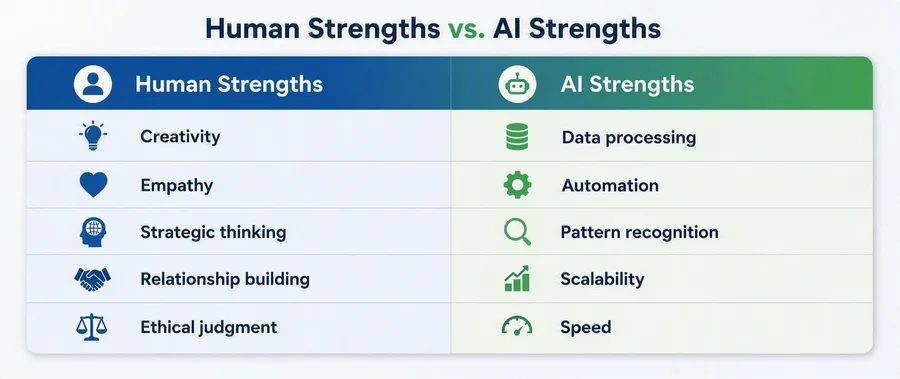
Relying solely on artificial intelligence often leads to impressive short-term results but runs into real limitations. AI systems can analyze millions of customer interactions, predict demand with high accuracy, and automate workflows, but they lack context, nuance, and ethical reasoning. A recommendation engine might suggest products based on past purchases, but it cannot read the room when a customer is frustrated or understand cultural differences that influence buying decisions.
In contrast, relying solely on human talent creates bottlenecks. Even the most skilled teams get overwhelmed by volume, suffer from fatigue, and make inconsistent decisions under pressure. Scaling operations without technological support quickly becomes expensive and slow. In competitive markets, these constraints translate into missed opportunities and higher costs.
The data backs this up. Around 78% of companies have adopted AI technologies, and 65% of organizations use generative AI in at least one business function. At the same time, Microsoft’s 2026 Work Trend Index found that 58% of AI users are producing work they could not have produced a year earlier, a figure that rises to 80% among advanced users. Additionally, 66% say AI allows them to spend more time on higher-value work. These findings show that AI is helping employees work more efficiently and focus on higher-value tasks.
However, successful outcomes depend on more than simply deploying the technology. Microsoft’s report found that organizational factors such as culture, manager support, and talent practices account for more than twice the impact on AI outcomes compared with individual effort alone.
Which Jobs Are Most Likely to Be Augmented by AI?
Rather than eliminating roles outright, AI tends to reshape specific parts of a job while leaving the judgment-heavy parts to people:
- Customer support – AI handles and responds to routine inquiries, while people manage complex or emotionally sensitive cases.
- Administrative support – AI drafts, schedules, and files; people catch exceptions and make judgment calls.
- Data processing – AI cleans and structures data at scale; people validate accuracy and handle edge cases.
- Marketing – AI analyzes performance data; people set strategy, brand voice, and creative direction.
- Research – AI surfaces and summarizes information; people interpret findings and decide what matters.
The data supports this trend. AI-augmented knowledge work delivers an average productivity improvement of 40%, and the most successful organizations use AI to enhance employee capabilities while investing in training, reskilling, and change management.
Human-AI Collaboration vs. Full Automation
Human-AI collaboration and full automation are often discussed as if they are the same thing, but they serve different purposes.
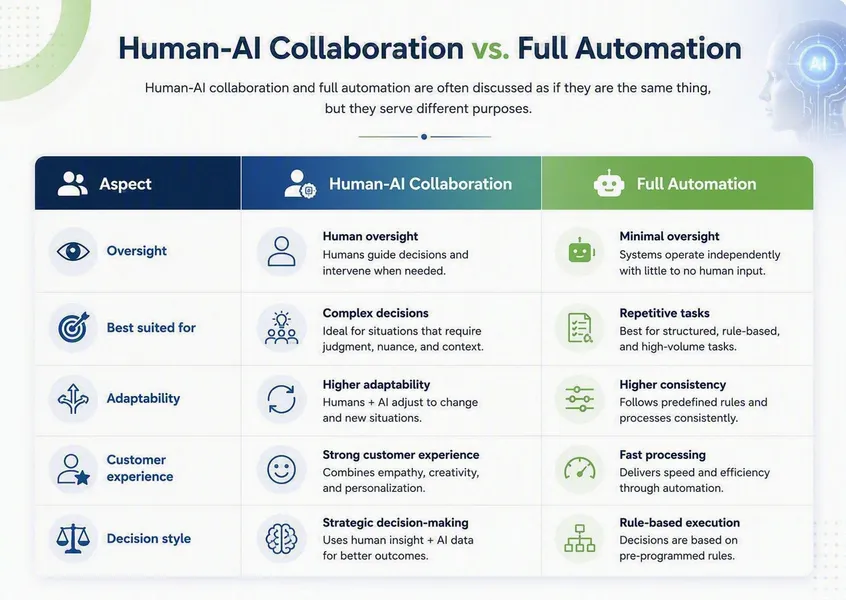
Full automation works best for repetitive, rules-based tasks where speed and consistency are the primary goals. Human-AI collaboration combines the efficiency of AI with human judgment, creativity, and decision-making. For most organizations, success comes from identifying which activities can be fully automated and which benefit from ongoing human involvement.
Human Skills That AI Cannot Replicate
Despite rapid advances in AI, certain capabilities remain uniquely human:
- Empathy – reading emotional cues and responding with genuine care
- Leadership – inspiring and aligning teams around a shared vision
- Ethics – weighing competing values in ambiguous, high-stakes situations
- Negotiation – balancing interests and building trust between parties
- Relationship building – sustaining long-term trust with customers and partners
- Strategic vision – setting direction based on judgment, not just data
Benefits and Business Outcomes of Human-AI Collaboration
Human-AI collaboration delivers value beyond efficiency gains alone. By combining automation with human expertise, organizations can improve both operational performance and business outcomes.
- Faster, smarter decision-making through AI-powered insights supported by human judgment
- Improved productivity by reducing time spent on repetitive tasks
- More personalized customer experiences through a balance of automation and human interaction
- Greater innovation by combining AI-generated ideas with human creativity
- Reduced operational costs through streamlined workflows
- Improved response times across customer-facing and internal processes
- Higher accuracy through human validation of AI outputs
- Stronger customer satisfaction and retention
- Faster execution of business initiatives and strategic decisions
Measuring the Success of Human-AI Collaboration
Human-AI collaboration sounds promising in theory, but success comes down to results. Organizations often look at a combination of performance and experience metrics to understand whether the partnership is creating real value.
- Productivity improvements – whether employees can accomplish more in less time.
- Cost savings – reduced costs through automation and streamlined workflows.
- Customer satisfaction scores – changes in CSAT, NPS, and other experience metrics.
- Resolution times – how quickly requests, issues, or tickets are resolved.
- Employee engagement – whether employees feel supported and empowered by AI.
- Error reduction rates – fewer mistakes and improved accuracy.
- Revenue per employee – a measure of overall productivity and business performance.
- Time-to-completion metrics – the time required to complete key workflows.
Together, these metrics provide a clearer picture of whether human-AI collaboration is driving meaningful business results.
Human-AI Collaboration Examples Across Industries
- Retail: Recommendation engines drive a large share of online sales, but store associates who understand local trends and build personal rapport are often what turns browsers into loyal customers.
- Finance: Algorithmic trading and fraud detection run 24/7, yet human analysts oversee risk models, ensure regulatory compliance, and handle high-stakes client relationships.
- Marketing: AI analyzes customer behavior and campaign performance at scale, but marketers develop the strategy, brand voice, and creative direction that help campaigns resonate with target audiences.
- HR: AI screens resumes and surfaces qualified candidates faster, while recruiters assess culture fit, soft skills, and the human factors a resume can’t capture.
Human-AI Collaboration in Practice
Over the past several years, VAfromEurope has supported organizations across customer support, operations, and AI-related workflows. A few patterns we see consistently:
- Customer support – AI-powered request routing paired with skilled specialists resolves complex or sensitive issues more effectively than either alone.
- Data annotation – maintaining AI performance requires ongoing data labeling, output validation, and exception handling long after initial training is complete.
- Back-office automation – automating scheduling, reporting, and data entry improves efficiency, but human oversight remains essential for exceptions and data quality.
- AI operations – incorporating human review into AI-driven workflows helps catch inaccuracies before outputs reach customers or internal teams.
This approach helps businesses improve efficiency and scalability without sacrificing service quality or customer satisfaction.
Common Challenges in Human-AI Collaboration
While human-AI collaboration offers significant benefits, organizations often face several challenges when implementing it effectively:
- Workforce concerns – Employees may be hesitant to adopt AI if they see it as a replacement for their role rather than a tool that supports and enhances their work. Clear communication, employee training, and effective change management are key to building trust and encouraging adoption.
- Data quality – AI systems rely on accurate, consistent data. Poor data quality can lead to unreliable outputs and reduce confidence in AI-driven decisions.
- Bias and reliability – AI models can reflect biases present in their training data, making human oversight critical for reviewing outputs and ensuring fair outcomes.
- Governance and accountability – Organizations need clear guidelines that define where AI supports decision-making and where human approval remains necessary.
- Skills and training gaps – Without proper training, employees may struggle to use AI effectively, limiting productivity gains and reducing the return on AI investments.
By combining strong governance, workforce development, and operational support, organizations can create the conditions for successful human-AI collaboration.
How to Build Successful Human-AI Collaboration
- Establish governance and ethics – set guidelines for when AI recommends versus decides, and be transparent about data usage and bias.
- Define clear human oversight roles – determine which decisions require human approval and which AI can manage independently.
- Train employees continuously – build skills not just to use AI tools, but to question outputs and interpret results.
- Integrate AI gradually – start with pilot projects that deliver quick wins without disrupting core operations, then scale based on results.
- Monitor AI performance regularly – review outputs consistently to catch issues early and maintain accuracy over time.
- Protect data privacy and security – ensure AI systems comply with relevant security and regulatory requirements.
- Shift culture – position AI as a collaborator, not a competitor, and regularly spotlight results the partnership made possible.
How BPO Supports Human-AI Transformation
Business process outsourcing can help organizations adopt AI more efficiently. Rather than building every capability internally, many companies combine AI tools with skilled outsourced teams that support customer service, quality assurance, and operational workflows. For many mid-sized businesses, this approach offers a faster and lower-risk path to scaling AI initiatives. Common starting points include administrative support, data entry, and AI operations services.
Emerging Human-AI Collaboration Trends for 2026
- Agentic AI in business operations – AI systems capable of managing multi-step tasks and workflows with minimal human input.
- Human-in-the-loop AI systems – workflows where people review, validate, or approve AI-generated outputs.
- AI governance as a board-level priority – growing executive oversight of AI strategy, risk management, and accountability.
- Increasing demand for AI quality assurance teams – dedicated specialists responsible for monitoring accuracy, identifying errors, and improving AI performance.
- Smaller, task-specific AI models – specialized models designed for particular business functions rather than broad, general-purpose use.
How VAfromEurope Helps Businesses Implement Human-AI Collaboration
Whether you’re just starting to explore AI or already running AI in production, the same question comes up: who catches what the model gets wrong, and who handles what it can’t do at all? That’s the gap we work in.
- AI-Enhanced Customer Support – AI handles routine inquiries and request routing, while experienced specialists manage complex cases, customer concerns, and interactions that require empathy and judgment.
- AI Operations Support – Ongoing oversight and management of AI-powered workflows, helping organizations maintain performance and efficiency without adding pressure to internal teams.
- Data Annotation and Validation – High-quality data labeling, output review, and quality assurance to support AI model training, accuracy, and continuous improvement.
- Virtual Assistant Services – Administrative and operational support that scales alongside AI adoption
- Back-Office Process Support – Human review of exceptions, complex scenarios, and quality control tasks to ensure accuracy, consistency, and reliable outcomes.
If you’re considering AI-powered customer support, data processing automation, or AI operations, our team can help design a scalable human-AI collaboration model tailored to your business goals.
Conclusion
Human-AI collaboration is no longer a future trend. It has become a critical component of how modern organizations improve efficiency, enhance customer experiences, and scale sustainably. Businesses that successfully combine AI capabilities with human expertise are better positioned to adapt, innovate, and achieve long-term growth.
At VAfromEurope, we help businesses create this balance by integrating intelligent automation with skilled support teams, enabling organizations to scale efficiently while maintaining high-quality service and exceptional customer experiences.
Frequently Asked Questions
What is human-AI collaboration?
Human-AI collaboration means using artificial intelligence as a supportive tool rather than a replacement. AI handles repetitive, data-heavy tasks while humans provide creativity, judgment, and emotional intelligence.
What is the difference between AI automation and human-AI collaboration?
Full automation removes people from a process entirely and works best for repetitive, rules-based tasks. Human-AI collaboration keeps people involved, typically reviewing, guiding, or approving AI output, and is better suited to complex or judgment-driven work.
What are examples of human-in-the-loop AI?
Examples include healthcare professionals reviewing AI-assisted diagnoses, support agents approving AI-generated responses, and moderators evaluating content flagged by AI before taking action.
How does human-AI collaboration improve productivity?
By automating repetitive tasks, AI frees employees to focus on higher-value work. This combination helps organizations improve efficiency, productivity, and overall performance.
What are the risks of relying entirely on AI?
Without human oversight, AI errors, bias, and unusual cases can go unnoticed and impact customers, operations, or business decisions. Human review and validation help reduce these risks and improve reliability.
What industries benefit most from human-in-the-loop AI?
Healthcare, finance, retail, manufacturing, and customer service all see meaningful gains, particularly where errors carry real cost or compliance risk.
How can small businesses implement human-AI collaboration?
Start with a small pilot project, such as AI-assisted customer support or automated reporting, while keeping a person involved in reviewing outputs. Once the process is delivering consistent results, it can be expanded to other areas of the business.
How can BPO providers support AI adoption?
BPO providers help organizations scale AI initiatives by combining automation with trained human teams managing support, QA, data annotation, and operations.