
Virtual Assistant vs. AI Assistant: Which Is Better for Growing Companies?
Growing companies facing heavy workloads don’t have to choose between human virtual assistants and AI – the most effective path to scale is a hybrid model. While AI handles high-volume automation, data processing, and 24/7 speed, human assistants provide essential judgment, empathy, and customer relationship management. Combining AI efficiency with human oversight allows businesses to boost productivity and scale operations without losing quality or personal touch.
Every growing company hits the same wall. Inboxes overflow, bookings pile up, reports run late, and the founder is still answering customer emails at 10 p.m. Something has to give, and the question is what to hand the work to.
Two options dominate the conversation: virtual assistant services staffed by real people, and an AI virtual assistant that automates work with software. Should you hire a virtual assistant or use AI? Can AI replace a virtual assistant altogether?
The short answer is that it depends on the work. Most growing companies do best with a combination of both. This guide breaks down how each option works, where each one shines, and how to decide what fits your business.
Quick Answer
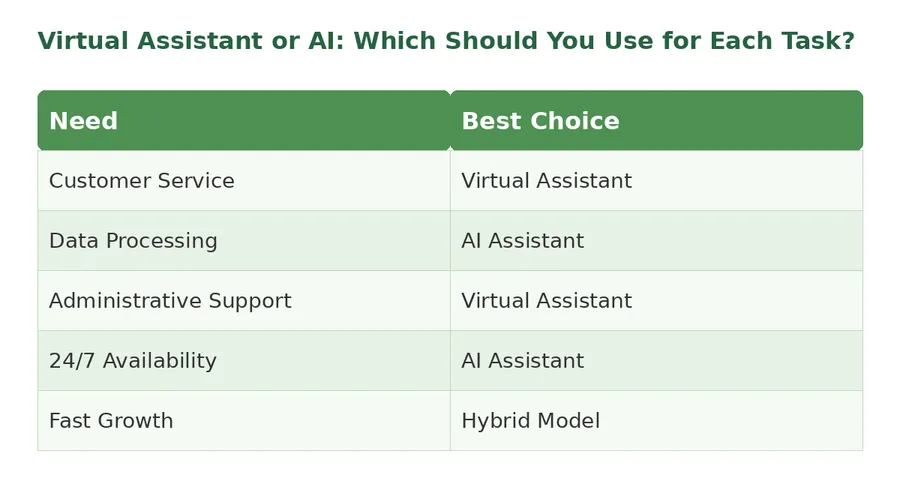
- If your work requires human judgment, relationship management, and personalized communication, choose a virtual assistant.
- If your work is repetitive, data-driven, and highly scalable, choose an AI assistant.
- For most growing businesses, the best solution is a hybrid model combining AI automation with human oversight.
Can AI Replace a Virtual Assistant?
Not entirely. AI can automate many scheduling, reporting, and data-entry tasks when workflows are standardized and properly configured, but it cannot replace human judgment, empathy, relationship management, and problem-solving.
A virtual assistant is better for communication, client relationships, and administrative support. AI is better for repetitive and scalable tasks. Which is “better” depends on the work you need done.
What Is a Virtual Assistant and How Does It Help Businesses?
A business virtual assistant is a remote professional who supports your company with administrative, operational, or customer-facing work. A remote virtual assistant might manage your calendar, handle email, coordinate with clients, process bookings, or follow up on invoices. Many companies use this model for outsourcing administrative tasks without the overhead of a full-time in-house hire.
Key virtual assistant benefits include flexible capacity, lower cost than a full-time employee, and the ability to delegate work that would otherwise pull you away from sales and strategy.
The real value of a human assistant is judgment. A person can read the tone of a client’s email, notice that a request doesn’t quite add up, and decide when to escalate an issue. That is why many businesses hire a virtual assistant when relationships and nuance matter.
What Is an AI Virtual Assistant for Business?
An AI business assistant is software that uses artificial intelligence to perform tasks such as drafting text, answering common questions, summarizing documents, analyzing data, and automating routine workflows. It works around the clock, handles large volumes without tiring, and scales almost instantly.
For many companies, the challenge is not simply a lack of staff but the growing volume of communication and coordination. As workloads increase, businesses are increasingly using AI to help prioritize, summarize, and automate routine tasks while assigning prioritization, follow-up, and sensitive communication to people.
But AI works best within clear boundaries. It follows patterns well, and it struggles with ambiguity, emotion, and unfamiliar situations. AI outputs can occasionally be inaccurate or inappropriate, which is why many businesses use human review for customer-facing or high-impact work.
Virtual Assistant vs. Chatbot: What’s the Difference?
A chatbot is a narrow tool, usually scripted, that answers questions in one channel, like a website chat window. A human virtual assistant works across tools and channels, exercises judgment, and can handle situations no script anticipated. A modern AI assistant falls in between: more flexible than a basic chatbot, but still dependent on setup, guardrails, and human review.
Popular AI Assistant Tools for Business
Several AI tools now support day-to-day business work, and a virtual assistant can work alongside each of them:
- Microsoft Copilot: Drafts emails, summarizes meetings, and builds first-pass documents inside Microsoft 365. A virtual assistant reviews and sends them, and manages the follow-up.
- ChatGPT: Useful for drafting, brainstorming, and research. A virtual assistant checks facts, edits for brand voice, and decides what is worth using.
- Claude: Strong at summarizing long documents and drafting careful written content. A virtual assistant verifies details and tailors the output to each client.
- Google Gemini: Supports work across Google Workspace, such as Gmail, Docs, and Sheets. A virtual assistant turns its output into finished, approved work.
- Notion AI: Helps summarize notes and organize knowledge bases and project pages. A virtual assistant keeps those work spaces accurate and current.
In each case, the pattern is the same: the tool produces speed and volume, and the person provides quality control and context.
AI Assistant vs Human Assistant: A Side-by-Side Comparison
Here is how the two stack up on the factors that matter most to growing companies.
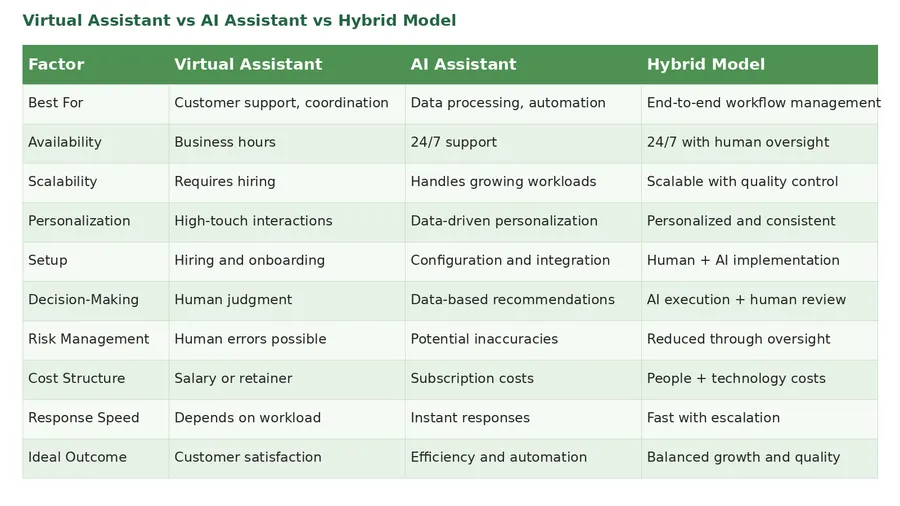
Actual cost, accuracy, and ROI depend on the selected tools, workflow complexity, implementation quality, and level of human oversight.
A few things stand out.
Cost. Both options are cheap to start. Over time, an AI assistant usually costs less per month because you pay for software rather than human hours.
Scalability. AI wins here. If your volume triples overnight, an AI tool absorbs it. A human assistant has a fixed capacity, so growth means adding people.
Management. This is the counterintuitive one. A skilled virtual assistant often needs less day-to-day supervision because they can think for themselves. AI tools need setup, prompt refinement, monitoring, and correction, so the management burden is often higher than people expect.
ROI. Both deliver strong long-term returns, but in different ways. A virtual assistant gives you time back and stronger relationships. AI gives you speed and capacity.
AI Assistant or Virtual Assistant for Small Business?
Small businesses feel these constraints the most, since there’s rarely budget or time to run both at full scale from day one.
Solo founders usually see the fastest relief from an AI assistant. It can draft emails, schedule, and summarize without adding payroll.
Startups in growth mode often add a virtual assistant first. Fundraising, hiring, and customer conversations need human judgment.
Small tourism companies let AI handle routine itinerary and pricing questions, freeing a human to manage bookings and special requests.
Agencies use AI for first-draft content and reporting, while a virtual assistant manages client relationships and deadlines.
eCommerce shops often start with AI for FAQs like shipping and returns, then add a virtual assistant as complaints and order issues grow.
Start with the option that solves your biggest bottleneck today, then add the other as your business grows. Small businesses can absolutely use AI and virtual assistants together, and many do from day one.
Research on AI, Productivity, and Human Oversight
Evidence on AI and productivity is more mixed than it’s often presented, which is exactly why human oversight matters.
- Microsoft’s 2025 Work Trend Index special report, Breaking down the infinite workday, reports that the average worker receives 117 emails and 153 Teams messages per weekday, with interruptions occurring roughly every two minutes during core work hours.
- Gartner surveyed 724 professionals in 2024 and found that only 37% of teams using traditional AI and 34% of teams using generative AI reported high productivity gains. Gartner recommends resetting expectations and redesigning workflows around AI rather than layering it on top of existing processes. (Gartner)
- McKinsey estimates that generative AI could increase annual labor-productivity growth by 0.1 to 0.6 percentage points through 2040. This is a forecast, and McKinsey ties these gains to effective implementation and workers’ ability to shift into new activities, not to the technology alone.
- Deloitte’s 2026 Global Human Capital Trends report, surveying more than 9,000 business and HR leaders across 89 countries, found that only 14% of leaders feel adept at shaping human-AI interactions. Organizations that design that collaboration intentionally are nearly 2.5 times more likely to report better financial results than those that don’t.
Small businesses increasingly combine automation with outsourced support rather than choosing one or the other.
Where Virtual Assistants Need AI Support
Even the best human assistants spend a lot of their day on work that doesn’t need a human brain. This is where AI earns its place as a support tool.
Repetitive tasks
Data entry, appointment reminders, form processing, and routine email replies are all high-volume and low-judgment. Automating them frees your assistant for higher-value work.
Data-heavy workflows
Sorting spreadsheets, cleaning lists, and pulling figures from multiple systems is slow and error-prone by hand. AI can significantly speed this up, though results should still be reviewed for accuracy.
Reporting
AI can compile weekly or monthly reports automatically, so your assistant reviews and refines them instead of building them from scratch.
Document generation
Proposals, invoices, meeting summaries, and standard contracts can be drafted by AI, then checked by a person before anything goes out.
Research
Market scans, competitor summaries, and background research that once took hours can be produced as a first pass in minutes. A human then verifies the facts and decides what matters.
Why Businesses Combine AI Assistants and Virtual Assistants
Many growing companies use a hybrid model, combining AI efficiency with human oversight for quality, context, and exceptions. This approach is often called the hybrid workforce model, and it rests on AI and human collaboration.
The logic is simple: give each side the work it does best.
AI handles repetitive tasks
Drafting, sorting, summarizing, scheduling, and answering routine questions all go to AI. It’s fast, consistent, and available 24/7.
Humans manage relationships
Client calls, negotiations, sensitive emails, and problem-solving stay with your virtual assistant. Trust is built between people, not between a customer and a chatbot.
Faster service delivery
When AI produces the first draft and a human polishes it, turnaround times drop sharply. Customers get quicker responses without a drop in quality.
Improved productivity
By automating routine work, businesses can focus more time on customer service, growth, and higher-value activities.
Better customer experience
Customers get the speed of automation and the warmth of a real person. That combination is hard to achieve with either option alone. It’s also why a hybrid setup works well for call center support and customer service.
What Is Human-in-the-Loop Support?
Human-in-the-loop support is a working model in which AI does the first pass and a person stays responsible for the result. AI can sound confident even when it’s wrong, so human oversight is what keeps quality, tone, and accountability intact. It typically follows four steps:
- AI drafts. The tool produces the first version of an email, report, reply, or summary.
- Human reviews. A person checks accuracy, tone, and completeness.
- Human approves. Nothing client-facing or high-stakes goes out without sign-off.
- Human handles exceptions. Unusual, emotional, or sensitive cases go straight to a person.
This review step helps maintain quality, consistency, and accountability. That’s why human-in-the-loop customer service and human-in-the-loop workflow management are now standard practice in well-run hybrid teams.
Data Privacy and Security: What Growing Companies Should Consider
Before assigning business tasks to an AI assistant, companies should assess:
- What customer or employee data the tool will receive
- Whether prompts and uploaded files are stored
- Whether that data may be used to improve future models
- Which employees and contractors can access the information
- Whether the tool supports your contractual and regulatory obligations
- Which outputs require human approval before going out
- How errors or inappropriate outputs will be reported and corrected
A virtual assistant should follow the same principles: access to only the accounts and data their role requires, no shared passwords, and access revoked as soon as it’s no longer needed.
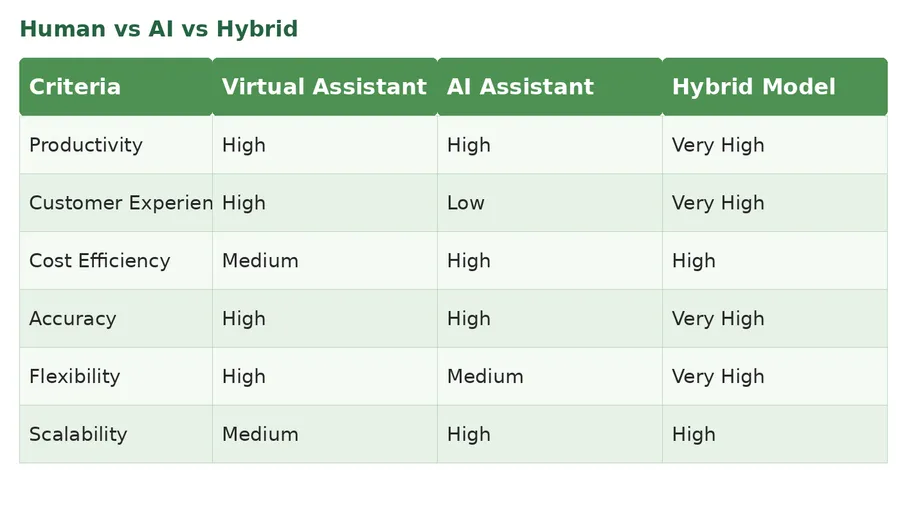
The hybrid model matches or beats both single-option approaches in nearly every category. The two areas where it doesn’t lead outright are cost efficiency and scalability, where it ties with pure AI. In return, you get much better customer experience, accuracy, and flexibility.
Which Solution Is Best for Your Business? How to Decide
There’s no universal answer, but there are clear signals. Use these checklists to find your fit.
Choose a Virtual Assistant If:
- Your business relies on relationships
- You need customer communication handled personally
- You need administrative support across varied tasks
- You require human judgment
Choose an AI Assistant If:
- You process large amounts of data
- You need 24/7 automation
- Your workflows are repetitive and predictable
- You need content generation support
Choose Both If:
- You are scaling rapidly
- You want efficiency and personalization
- You seek long-term growth
If more than one list sounds like your business, that’s normal. To decide task by task, ask these five questions about anything you’re thinking of handing off:
- Does the task require empathy?
- Does the task require judgment?
- Is the task repetitive?
- Is customer trust involved?
- Can mistakes have serious consequences?
How to read your answers:
- Yes to questions 1, 2, 4, or 5 – assign it to a human virtual assistant.
- Yes only to question 3 – assign it to AI.
- A mix, such as a repetitive task where trust is involved – use the hybrid model: AI drafts, a human reviews.
How Businesses Use AI and Virtual Assistants Together
These examples show how businesses combine the two in practice.
Small Tourism Company
A small tour operator gets a steady stream of inquiries about dates, prices, and itineraries. AI drafts responses to common questions, so replies go out quickly. The virtual assistant manages bookings, confirms details, and handles special requests such as dietary needs or accessibility. Travelers get fast answers and a real person for anything important.
Marketing Agency
An agency uses AI to create first drafts of content, social captions, and campaign outlines. The virtual assistant coordinates clients, gathers feedback, manages deadlines, and makes sure the final work reflects what each client wants. Creative output goes up while client relationships stay personal.
eCommerce Store
An online store uses AI to handle FAQs about shipping, returns, and sizing, which covers the bulk of incoming questions at any hour. The virtual assistant resolves complex requests such as damaged orders, custom requests, and upset customers, where empathy and judgment matter.
Healthcare Administration
A clinic may use approved automation for appointment reminders and routine scheduling. Patient communications, insurance questions, symptoms, billing disputes, and other sensitive matters should be handled through appropriately secured systems and escalated to authorized staff.
Real Estate
AI drafts listing descriptions, answers initial buyer questions, and schedules showings around the clock. The agent or their assistant takes over for negotiations, contract questions, and anything involving a client’s specific circumstances.
SaaS Companies
AI powers tier-one support – password resets, how-to questions, and basic troubleshooting while a human support or success manager steps in for churn-risk accounts, technical escalations, and renewal conversations.
Professional Services
Law firms, accountants, and consultancies use AI to draft standard documents, summarize meetings, and organize client files. Human-in-the-loop review stays mandatory for anything client-facing or legally binding.
The pattern is the same across every industry: AI takes the first pass, and a human takes ownership of anything that needs care.
Final Thoughts
The virtual assistant vs AI assistant debate is usually framed as a choice, but for growing companies it’s better seen as a division of labor. AI is unmatched at speed, volume, and repetition. Human assistants are unmatched at judgment, empathy, and relationships.
If you’re just starting out, pick the option that fixes your biggest bottleneck today. If you’re scaling, build a hybrid workflow, with AI doing the heavy lifting and people owning the moments that matter. That’s how businesses stay fast without losing the human touch.
Not sure which tasks to automate and which to delegate? Talk to VAfromEurope about building a practical support model that combines AI efficiency with human judgment, quality control, and customer care.
Frequently Asked Questions
Can AI replace a virtual assistant?
Not entirely. AI can automate data entry, scheduling, and basic support, but it can’t replace human judgment, relationship-building, or the ability to handle unusual situations. For many businesses, AI complements a virtual assistant rather than replacing one entirely.
Is a virtual assistant better than AI?
A virtual assistant is better for communication, client relationships, and administrative support. AI is better for repetitive and scalable tasks. The right choice depends on the task and business needs.
What tasks should I automate with AI?
Start with repetitive, rules-based work: appointment reminders, FAQ replies, data entry, report compilation, first-draft documents, and basic research. If a task follows a predictable pattern and a mistake is low-stakes, it’s a good candidate.
What tasks should never be fully automated?
Anything involving sensitive customer situations, complaints, negotiations, legal or financial commitments, or decisions with serious consequences should keep a human in-the-loop.
Can small businesses use AI and virtual assistants together?
Yes, and this is where many small businesses see the best results. AI handles volume and speed while the virtual assistant provides oversight, judgment, and personal contact. This is the core of the hybrid model.
How much does a virtual assistant cost?
It varies widely based on skill level, experience, location, and whether you pay hourly or on a monthly retainer. General administrative support costs less than specialized work such as bookkeeping, marketing, or technical support. Compare a few providers and be clear about the tasks you need before you commit.
Is AI safe for handling sensitive business information?
AI can be safe when implemented correctly, but businesses should verify how data is stored and processed. For confidential information, financial records, customer data, or regulated industries, human oversight and secure policies remain essential.
What are the risks of using AI assistants?
Common risks include inaccurate responses, data privacy concerns, compliance issues, lack of human judgment, and over-reliance on automation. These risks can usually be reduced through proper review processes and human supervision.
What is the best solution for a growing company?
For most growing companies, a hybrid model. It scales with your volume, keeps service personal, and lets you add capacity without adding chaos.