

Viral Marketing Key Elements: How to Achieve Viral Growth
Viral marketing can help businesses grow rapidly by encouraging customers to share products and services with others. This article explains the key drivers of viral growth, including the Viral Coefficient and Viral Cycle Time, and explores why platforms like YouTube achieved massive success. It also highlights how businesses can combine viral marketing with SEO, paid advertising, and other strategies to attract more customers.
Discovering approaches to get more clients in a cheap & easy way is a tremendously vital aspect for businesses, especially startups. The ideal plan of action looks like this: Viral client engagement converted into money. A little number of organizations really could accomplish genuine viral development, because viral growth is a subtle objective.
In 2007, YouTube successfully implemented basic elements of viral marketing strategy and achieved amazing viral extension. To define these key elements of successful viral marketing, it’s necessary to compare its story with the story of Tabloid, the startup launched at the same time in 2007. Tabloid has all the means and potential to get this viral growth, but YouTube got far ahead. In this post, you’ll find the tips and special features of viral marketing.
Viral extension depends on two basic elements: the Viral Coefficient and the Viral Cycle Time. Not to dig deep into the technical part of the question and formulas, the Viral Coefficient could be calculated easily: it is the number of invites sent out by each customer multiplied by the number of invites converted into clients (%. You have to remember, to make a mistake, that the number of invites sent by your new customers isn’t constant.

Considering cycles of growth, it’s important to mention that new clients that were included in the earlier cycle convey solicitations. This happens because it is very improbable that the whole populace will keep on sending invitations each cycle. Many entrepreneurs make such a mistake while calculating this coefficient. Viral growth demands the Viral Coefficient be more than 1. If it’s not like this, that means no viral growth. The thing that influences this coefficient is the increasing number of invites sent by your customers.
The viral cycle looks like this:
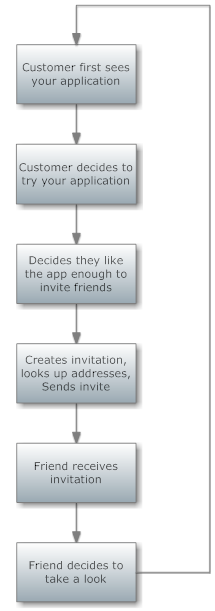
The time required for the whole cycle to complete is the Viral Cycle Time. Returning to the comparison analysis of YouTube and Tabloid, YouTube had a shorter Viral Cycle Time to a great degree: people would just go to the site, see a clever video, and instantly send it on to others. Tabloid is an image-sharing platform, where users have to post photos and share with friends. Months may pass before others will take pics and upload them on Tabloid, so it made the duration of Viral Cycle Time a longer process.
The table below vividly shows the effect of the time spent for the cycle to complete.

Looking at the table, you will conclude that a shorter duration of the cycle influences the viral growth amazingly. With a cycle duration of 2 days in twenty days, you’ll get 20 thousand and a half customers, but with a duration reduced to one day for a cycle, this number of customers increases to more than 20 million! That means the lessening of Viral Cycle Time influences the whole situation more than enlarging the Viral Coefficient.
That’s why YouTube gained so many clients in a tiny period of time and became so powerful and popular.
Marketers alone cannot achieve viral growth through their efforts. We should integrate virality potential into the product during its invention and manufacturing, with designers and engineers guiding the build. Let’s think about the most virally successful platforms, for example, Skype. The extension scheme was built like this: you can call anywhere at low cost or for free, but only to your contact list in Skype (e.g., friends). The product must function whenever users share it, and it must be social to achieve virality. This approach will give people a strong reason to share it widely. Offering clients a reward for each client they effectively convert is an advantageous approach to build virality.
The majority of business specialists and marketers may understand, with the help of this post, that they might not have the abilities to accomplish genuine viral development (with the Viral Coefficient more than one). As opposed to surrendering, it merits considering a hybrid viral strategy; the hybrid viral strategy compensates for the deficiency in clients by procuring them through some different means, for example, SEO or paid inquiry. Think about hiring a virtual assistant
to help you with performing this strategy.
Source:
for Entrepreneurs