

How BPO Accelerates AI Development
AI development is often slowed not by engineering limitations, but by operational bottlenecks such as data annotation, testing, validation, and multilingual quality assurance. This article explains how BPO support helps AI companies overcome these challenges by outsourcing repetitive, high-volume workflows to specialized teams. By integrating scalable operational support across the AI lifecycle, businesses can accelerate deployment, improve model quality, reduce costs, and allow engineering teams to focus on innovation. The article also explores human-in-the-loop testing, multilingual AI support, real-world use cases, and key factors to consider when choosing an AI-focused BPO partner.
Software companies creating AI-powered solutions often struggle to move models from prototype to production because operational workflows such as data annotation, testing, and validation fail to scale efficiently. As these workflows grow more complex, they become increasingly difficult to manage, delaying releases and pulling engineers away from core development work. In many cases, the biggest obstacle to AI deployment is not the model itself, but the operational infrastructure required to support it.
What is AI BPO support?
AI BPO support refers to outsourcing operational AI workflows, such as data annotation, model validation, testing, and quality assurance, to specialized external teams. It allows engineering teams to focus on model development while a dedicated partner handles the repetitive, high-volume operational work.
Key Takeaways
- AI constraints are often operational, not engineering-related.
- BPO support helps scale annotation, testing, and validation
- Human-in-the-loop workflows improve AI reliability
- Multilingual annotation supports global AI deployment
- Outsourcing repetitive tasks frees engineers to focus on innovation
The Hidden Bottlenecks in AI Development
The challenge is not always technical. Many AI teams already have strong engineering talent and solid infrastructure. The real slowdown comes from process-heavy tasks: data preparation, testing, validation, and continuous monitoring. These tasks consume engineering time and delay releases.
A common misconception is that hiring more engineers automatically speeds up development. In reality, without scalable operational support, additional headcount often adds coordination overhead rather than solving the underlying workflow inefficiency.
Business Process Outsourcing (BPO) steps in here as a strategic solution. Modern BPO support is no longer just about cost reduction. It functions as an operational extension of AI teams in handling data labeling, quality assurance, multilingual evaluation, and human-in-the-loop testing – all essential to a well-functioning AI operations strategy.
By offloading these time-consuming processes, AI companies can accelerate development cycles while improving output quality.
What Causes Bottlenecks in AI Product Development
AI development involves multiple stages beyond model training, and each introduces operational friction that can slow progress.
Data Annotation and Labeling Delays
Every successful AI system starts with high-quality training data. However, labeling large datasets takes time and resources. Growing datasets often place significant pressure on internal teams, requiring engineers to spend more time validating annotations than improving models.
Testing and Validation Overload
AI systems require continuous testing across edge cases, user scenarios, and failure conditions. Unlike traditional software, outputs must be evaluated for accuracy, bias, and contextual relevance. This creates heavy AI model validation workloads that grow with each iteration.
McKinsey’s State of AI research shows that organizations that successfully scale AI distinguish themselves by implementing structured validation and human oversight processes, an area where many companies still struggle during the pilot stage.
Multilingual and Domain Complexity
AI products often serve global users and specialized industries. To ensure accuracy across contexts, both native-language insight and domain-specific knowledge are essential. Internal teams rarely have the capacity to handle this at scale.
Lack of Scalable Processes
Many AI teams rely on manual workflows in early stages. While effective initially, these processes become bottlenecks as products scale, limiting the ability to iterate quickly and efficiently. AI workflow optimization closes this gap.
Engineering Teams Often Become the Bottleneck
Engineering teams are meant to drive innovation, but in many organizations, they become overloaded with operational tasks. Instead of focusing solely on model architecture, optimization, and feature development, annotation review, dataset preparation, and manual testing often pull engineers away from core work.
This constant context switching reduces productivity and slows development velocity. Senior engineers, whose time is most valuable, end up performing repetitive tasks that do not require deep technical expertise.
The result is slower iteration cycles, reduced experimentation, and increased burnout. The problem is not the availability of qualified professionals. It is the misallocation of that talent toward operational work instead of innovation.
How BPO Support Fits into the AI Development Lifecycle
BPO support integrates across the entire AI lifecycle, not just post-development tasks.
- Pre-training: BPO teams assist with data collection, cleaning, and preparation, ensuring datasets are structured and reliable.
- Training: They handle large-scale annotation, labeling, and quality assurance under structured workflows.
- Testing: Human-in-the-loop evaluation becomes essential here. BPO specialists evaluate outputs, assess response quality, and identify edge cases that automated systems often overlook. This reflects the same principle Microsoft highlights in its guidance on human-in-the-loop patterns for AI systems, where teams place human checkpoints at the points of highest ambiguity or risk.
- Post-deployment: they support ongoing monitoring, feedback analysis, and continuous model improvement.
This integration allows AI companies to maintain development speed without sacrificing quality or overloading internal teams, making end-to-end AI support services a practical alternative to building every function in-house.
How BPO Support Reduces AI Bottlenecks
Scalable Data Annotation & Validation
BPO teams provide access to trained annotators who can scale quickly based on project needs. Companies offering AI data annotation services can rapidly expand labeling capacity while maintaining quality standards. Rather than expanding internal teams for each project, companies can scale efficiently with external support. Multi-step QA systems help maintain reliability and precision, minimizing revisions and improving AI model outcomes, especially in large-scale data labeling projects where mistakes can spread quickly across datasets.
Human-in-the-Loop Testing
AI systems, especially generative models, require human judgment to evaluate outputs. Through human-in-the-loop AI testing workflows, BPO specialists systematically assess prompts, chatbot responses, and model behavior across a range of scenarios. This improves reliability and reduces the risk of production issues.
Multilingual & Domain Expertise
BPO providers often bring access to native-language reviewers and industry specialists who understand cultural nuances and domain-specific terminology. Native reviewers support multilingual data annotation across different languages and industries.
This ensures AI systems perform consistently across regions and specialized domains, improving global scalability.
Faster Iteration Cycles
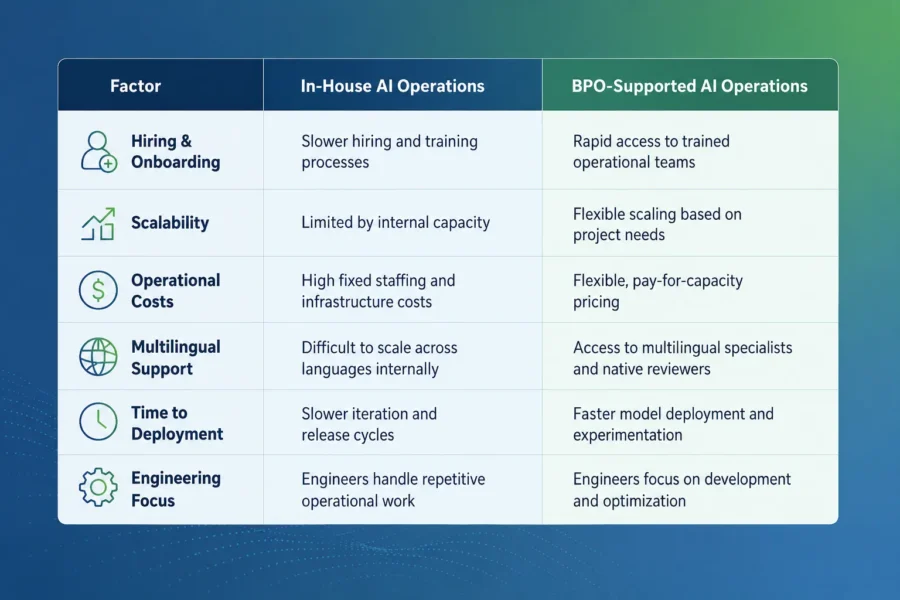
By outsourcing repetitive operational tasks such as AI data labeling and quality validation, engineering teams receive cleaner datasets and faster feedback loops. This shortens the time between model updates, enabling faster experimentation and continuous improvement. Better data quality leads directly to better model performance.
Cost Efficiency Without Compromising Quality
Building an in-house operations team means hiring, training, infrastructure, and long-term investment. BPO offers a more agile path forward. Capacity scales with demand, not fixed headcount. Businesses gain a dedicated AI outsourcing team, without the overhead of growing an internal one.
This allows AI companies to allocate budgets more effectively, while investing in core engineering and model development and outsourcing repetitive operational work. As a result, organizations gain predictable costs and scalable execution.
Real-World Examples of BPO Impact on AI Teams
Teams experienced in supporting machine learning projects understand annotation guidelines, edge case handling, quality assurance protocols, and secure data workflows. This operational know-how is what separates dependable BPO partners from generic outsourcing vendors.
Consider a multilingual NLP startup expanding into five new markets. Instead of building internal language teams, they partner with a BPO provider to handle annotation and validation. This allows them to scale datasets across languages in weeks instead of months.
These benefits extend beyond individual cases. According to a study by Deloitte, implementing AI can enhance process efficiency by up to 40%, largely through automation of repetitive tasks, intelligent data processing, and advanced analytics. McKinsey found similar results: companies using AI in their BPO processes can cut operational costs by as much as 30%.
Based on our internal experience, a chatbot company reduced testing cycles by up to 40% by using BPO-supported human-in-the-loop testing for thousands of conversational flows. The approach also improved response accuracy and reduced operational workload before deployment.
Similarly, an AI platform outsourced repetitive QA and dataset validation tasks through AI operations support services, allowing senior engineers to focus on model optimization and product development. This resulted in faster iteration cycles and improved product stability.
This is the range of support VAfromEurope’s AI specialists bring to AI teams, covering multilingual annotation, testing, and quality assurance, without the overhead of building an internal team.
These examples highlight a consistent pattern: when teams externalize operational work, engineering teams move faster and build better systems.
How to Start: Pilot → Scale → Dedicated Team
Adopting BPO support does not require a large upfront commitment. Many organizations start with a pilot AI outsourcing project before expanding into dedicated operational teams.
Once teams establish quality and workflow alignment, they define KPIs such as accuracy, turnaround time, and consistency. Based on the results, they gradually scale operations and expand their scope.
Over time, many organizations bring in dedicated BPO teams as part of their workflows. In effect, BPO becomes a long-term extension of their engineering function.
What AI Companies Should Look for in a BPO Partner
Choosing the right BPO partner is critical for success. Companies should evaluate providers based on:
- Experience with AI outsourcing services and QA processes
- Scalability and secure workflows.
- Security and compliance credentials are also essential. NDA agreements, data protection standards, and secure infrastructure should be non-negotiable, along with recognized certifications.
- Integration capability. The best BPO partners align with existing tools, documentation systems, and engineering workflows to ensure seamless collaboration.
Summing up
AI development success depends not only on technical innovation but also on operational efficiency. Without scalable processes, even the most advanced engineering teams face delays and inefficiencies.
BPO support addresses this gap by removing repetitive operational burdens and enabling engineers to focus on what they do best, which is building intelligent systems.
Rather than replacing internal teams, BPO acts as an accelerator that keeps AI development moving faster, cleaner, and more efficiently.
If your AI team is overwhelmed by annotation, validation, or testing workflows, can provide scalable operational support tailored to your AI pipeline.
FAQ
What is AI BPO support?
AI BPO support refers to outsourcing operational AI workflows, such as data annotation, model validation, testing, and quality assurance, to specialized external teams.
When is it the right time for AI companies to consider BPO support?
When data preparation, testing, or validation begins slowing down release cycles or consuming engineering time.
What tasks can be outsourced?
Annotation, QA testing, multilingual validation, and repetitive data operations are common AI outsourcing services.
These services help engineering teams scale efficiently while allowing internal teams to focus on core product development.
How is quality ensured?
Quality is maintained through structured QA, multi-level review processes, and experienced AI quality assurance specialists.
How much does AI outsourcing cost?
Costs depend on project scope, data volume, and complexity, but BPO is generally more affordable than building an in-house team.
Most providers offer flexible pricing models, including hourly rates, per-task fees, or monthly packages, so you only pay for the capacity you use.
Is VAfromEurope secure for sensitive AI data?
Yes. Security and data handling are treated as a priority at every stage.
At VAfromEurope, we follow security practices, including NDAs, secure systems, and GDPR-aligned processes.
We also work in line with internationally recognised standards such as ISO 27001, ISO 9001, and ISO 42001, allowing businesses to handle sensitive AI data confidently and securely.