
Which Business Processes Should Small Businesses Outsource First?
Discover which business processes small businesses should outsource first and how to choose the right starting point. This guide covers administrative support, bookkeeping, customer service, HR, IT, marketing, and website management, plus practical tips for selecting a provider, protecting business data, measuring results, and scaling outsourced support.
What Should a Small Business Outsource First?
If you run a small business, you know how many roles you end up playing in a single day. One hour you are closing a sale, the next you are reconciling invoices, answering support emails, or fixing a broken website. That juggling act is exactly why so many owners start looking for work they can hand off to someone else.
Small businesses should usually outsource repetitive, time-consuming, non-core business processes first, especially work that is easy to document and measure.
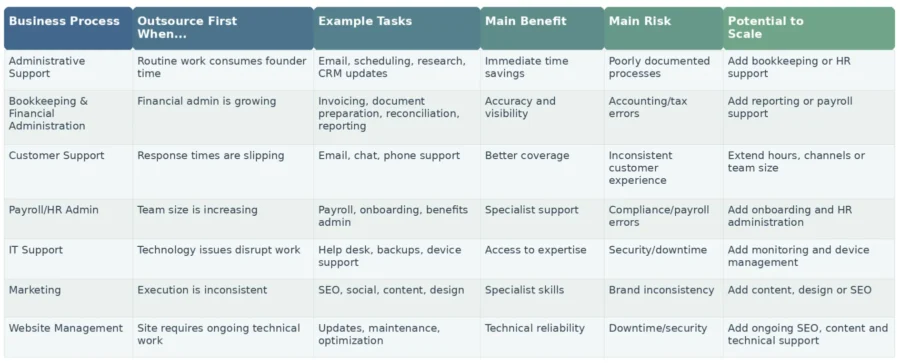
For many businesses, administrative support and routine financial administration are good starting points, followed by customer support, payroll and HR administration, IT support, marketing execution, and website maintenance.
Start with one process, define the expected outcome and KPIs, run a pilot, and expand once the model works reliably.
Key Takeaways
- Start with repeatable, non-core work you can document and measure.
- Let your biggest bottleneck determine the first process to outsource.
- Prioritize security, clear responsibilities, and regular communication when selecting a provider.
- Outsource execution, not ownership.
- Start with one function and expand the scope as the partnership proves successful.
Business Processes to Outsource First: Quick Comparison
How to Decide Which Business Process to Outsource First
Outsourcing is not just a cost-cutting tactic. For small teams, it is often a growth strategy: it saves time, gives you specialist skills without a full-time hire, lets you scale flexibly in busy seasons, and reduces errors where compliance and accuracy matter. The key is being selective. Outsourcing everything at once creates confusion. Outsourcing the right things first creates momentum.
The 5-Question Outsourcing Test
Before outsourcing a process, ask:
- Repeatability: Can the task be described with clear steps?
- Strategic value: Is it outside your core expertise, meaning it does not create your competitive advantage?
- Time cost: Does it eat hours you could spend on sales or strategy?
- Control: Can performance and risk be measured, and are mistakes easy to catch and fix?
- Scalability: If the workload grows, will you need additional hours, another skill set or another team member?
A process that is repeatable, non-core, time-consuming, measurable and scalable is generally a strong candidate. The simplest work to hand off first is data entry, research, scheduling, inbox management, basic customer support and social media execution. Bookkeeping, payroll, cybersecurity and compliance-related tasks are also good candidates, but they call for stronger specialist or provider controls.
Why Small Businesses Use External Support
Small businesses often reach a point where keeping every operational function in-house becomes inefficient. External support can provide access to specialized skills, additional capacity, and structured processes without requiring the business to build a separate internal role for every function.
Outsourcing can also help businesses respond to changing workloads. Support may begin with one process and expand as the company grows, or several specialists may support different parts of the business through one outsourcing relationship.
Deloitte’s Global Outsourcing Survey also points to continued investment in third-party outsourcing among the organizations it surveyed.
[Insert verified Deloitte statistic/source here if you want to keep the research reference.]
Regardless of the outsourcing model, clear responsibilities, communication, performance expectations, and quality controls remain critical.
7 Business Processes Small Businesses Should Outsource First
Administrative Support and Virtual Assistance
Administrative work is often the simplest to outsource first because tasks such as calendar management, inbox organization, data entry, CRM updates, web research, travel coordination, document preparation, and reporting can be clearly documented and measured.
The goal is not simply to remove tasks. It is to move repeatable operational work away from people whose time is better spent on sales, customer relationships, strategy, and decision-making. A virtual assistant or outsourced administrative team can handle these recurring tasks without requiring the business to create a separate full-time role.
Why outsource it: It is low-risk, easy to start, and delivers immediate time savings.
Businesses that want to delegate inbox management, calendar coordination, research, and recurring administrative work can explore our virtual administrative support services.
Bookkeeping and Financial Administration
Bookkeeping and financial administration include many repetitive tasks, such as invoice preparation, document organization, data entry, transaction recording, reconciliation preparation, and record maintenance. These activities can consume significant time that qualified accounting professionals could spend on work requiring specialist expertise.
Not every financial administration task requires an accountant. A trained back-office specialist can handle routine preparation, document processing, and record maintenance, while qualified accounting professionals remain responsible for work requiring accounting expertise, tax knowledge, or professional judgment.
Why outsource it: Separating routine financial administration from specialist accounting work helps businesses use professional expertise where it adds the most value while keeping recurring back-office work organized and up to date.
If invoices, documents, data entry, and financial records are consuming too much internal time, our data entry and back-office support can help manage the recurring administrative workload.
Customer Support
Handling every email, call, or chat yourself does not scale. Outsourced support can cover routine inquiries, order status questions and after-hours coverage through virtual receptionists, live chat and email teams, or help desk services for software and e-commerce businesses.
Why outsource it: Faster response times improve customer satisfaction, and your team is freed up for complex or high-value conversations.
Our customer support and call center services can cover inboxes, phones and live chat while you focus on growth.
Payroll and HR Administration
Payroll looks simple until you factor in tax withholdings, benefits and changing regulations. Qualified specialists can handle payroll processing and tax filings, benefits administration, onboarding paperwork and basic HR compliance.
Why outsource it: Errors damage employee trust and can lead to penalties. Specialists and payroll platforms make the process reliable and predictable, which matters most for growing teams.
IT Support and Cybersecurity
Most small businesses cannot justify a full-time IT department, yet technology problems can halt operations instantly. A managed IT provider can cover help desk and troubleshooting, network and device management, data backup and recovery, and cybersecurity monitoring.
Why outsource it: Downtime and data breaches are expensive, and expert support protects your business and your customers’ information.
Marketing and Content Creation
Marketing is essential, but it is also time-intensive and highly specialized. Good candidates include social media management, blog writing and SEO content, email marketing, graphic design, and paid advertising management.
Why outsource it: Consistent marketing drives growth, and specialists bring tools, experience, and creativity that are hard to build in-house. Social media management is often the easiest task to hand off first, and our social media management service is a simple way to begin.
Website Management and Development
Your website is your digital storefront. Design, updates, security patches, and performance optimization all require technical skill.
An outsourced website support team can manage recurring updates, maintenance, and technical improvements without requiring a full-time in-house web specialist.
Why outsource it: A well-maintained site builds trust and supports every marketing effort you make. See our website management and development services for ongoing updates, fixes, and improvements.
Can You Outsource Several Business Processes to One Provider?
Yes. Small businesses do not necessarily need a separate provider for every outsourced function. A BPO partner can manage one business process initially and expand into additional functions, specialists, or capacity as the client’s operational needs grow.
For example, a company might begin with administrative support and later add bookkeeping assistance and HR administration. Another business may need website management, social media support, and back-office assistance. In other cases, several specialists can work together on one larger function.
At VAfromEurope, we typically scale outsourced support in two ways: by gradually adding different business functions or by building a multi-skilled team around one operational area.
This approach allows a small business to start with a manageable scope while keeping the option to delegate more work as needs evolve.
Outsource, Automate, or Both?
Automation can handle individual steps, but it does not eliminate the need for human ownership of processes that involve judgment, communication, exceptions, or customer relationships.
Many small businesses therefore use a combination of automation and outsourced human support.
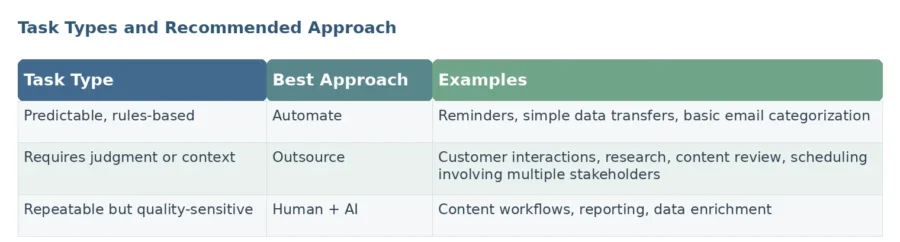
Rule of thumb: automate steps; outsource processes that still require context, judgment, communication, or accountability.
For a deeper look, read Virtual Assistant vs. AI Assistant: Which Is Better for Growing Companies? and Human-AI Collaboration: Why Businesses Need Both to Succeed.
Virtual Assistant vs Agency vs BPO: Which Outsourcing Model Is Right for a Small Business?
- Virtual assistant: best when you need one person to handle recurring administrative or operational tasks.
- Agency: best when you need specialized expertise in a particular area, such as marketing, website management, or creative execution, with structured management and access to several specialists.
- BPO provider: best when you want to outsource an ongoing business process or several operational functions with documented workflows, management, continuity, and the ability to scale.
The right model can also change as the business grows. A company may begin with individual support and move toward a broader BPO or multi-specialist model as its operational needs become more complex.
Alternatively, a provider can build a small team around one function when the workload requires several skill sets.
Security and Data Protection When Outsourcing
Outsourcing often means giving an external team access to business email, CRM systems, customer information, financial records, or internal platforms. Security should therefore be part of the provider-selection process from the beginning, not an afterthought.
Before outsourcing a process, clarify:
- Which systems and data the provider will access.
- Who within the outsourced team requires access.
- How credentials and permissions will be managed.
- Whether confidentiality and data-processing obligations are documented.
- How access will be changed or removed when responsibilities change.
- Who owns the business accounts, files and data.
A structured outsourcing provider can also make it easier to maintain documented responsibilities, continuity and access controls as the outsourced team grows.
Evaluate providers based on security, access controls, communication, relevant expertise, and measurable performance, not price alone.
How VAfromEurope Approaches Security and Quality
VAfromEurope is ISO 27001 certified and operates in line with GDPR requirements.
When working with clients:
- Access is limited to the systems and data each role requires.
- Access is changed or removed when responsibilities change, or an engagement ends.
- Clients keep ownership of their accounts, files, and data.
Which Business Processes Should Small Businesses Keep In-House?
Not everything should be outsourced, especially early on. Keep these close, unless appropriate governance is in place:
- Core strategy and vision. Direction should always come from you.
- Your unique product or service expertise. This is what differentiates you.
- Key customer relationships. Trust is built personally, so keep high-value conversations in-house even if routine support is outsourced.
- Final decision-making authority and sensitive leadership responsibilities.
How to Start Outsourcing a Business Process
- Audit your week. Track your tasks for one to two weeks and note how long each takes.
- List the biggest time drains. Highlight repetitive, low-value work.
- Prioritize one function. Start small rather than outsourcing everything at once.
- Document the process. Write clear instructions so a provider knows exactly what you expect.
- Choose the right partner. Compare experience, reviews, communication style, pricing and data security practices.
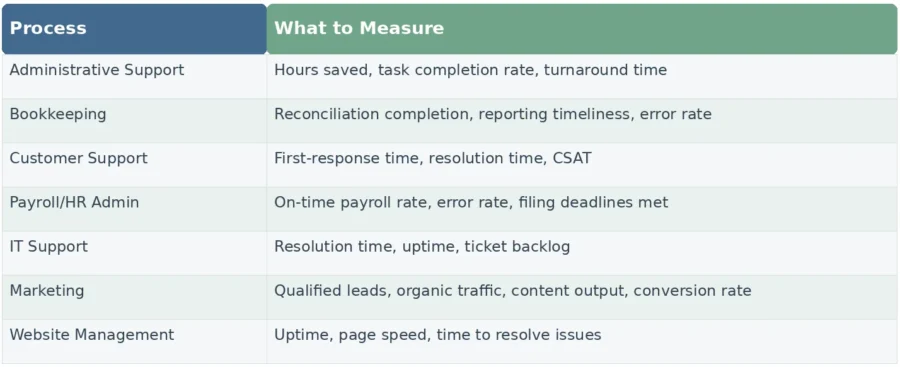
- Run a pilot. A small trial shows you how the relationship works before you commit. Choose one or two KPIs from the table below before it begins.
- Review and expand. Check results regularly, keep access to your accounts and data, and add the next function only when the first one works.
What we’ve learned from outsourcing transitions: At VAfromEurope, outsourcing can begin with one clearly defined responsibility or with several related areas, depending on the client’s needs. Some clients combine administrative and bookkeeping support, while others need support across website management, social media and back-office work. We can also build a team of several specialists around one operational function. What matters most is defining responsibilities, access, reporting, and communication from the start, then expanding the scope gradually as the working model proves successful.
How to Measure Outsourcing Success
Common Outsourcing Mistakes to Avoid
- Choosing on price alone. The cheapest option often costs more in rework and frustration.
- Ignoring data security. Make sure providers follow solid privacy and security practices, and put agreements in writing.
- Leaving expectations vague. Unclear instructions, deadlines, and reporting rhythms lead to inconsistent results.
Frequently Asked Questions
What is the first thing a small business should outsource?
For many small businesses, administrative support or bookkeeping is the easiest place to start. Administrative work offers quick time savings with relatively low operational risk, while bookkeeping is a strong candidate when financial administration is consuming significant internal time.
Can I start with one outsourced task and add more later?
Yes. A small business can begin with one clearly defined task or process and add functions, specialists or capacity once the working model is established.
Is it safe to give an outsourcing company access to business systems?
It can be, if access is managed deliberately. Define which systems and data the provider needs, give each team member only the access their role requires, keep ownership of your accounts and data, document confidentiality and data-processing obligations in writing, and remove or change access promptly when responsibilities change.
How much does business process outsourcing cost for a small business?
It depends on the type of work, the hours required, the skill level needed, and the provider model. Explore our BPO plans and pricing for current service options.
Can I outsource only a few hours per week?
Yes, depending on the provider and service model. Some outsourcing arrangements can begin with a limited scope or defined number of hours, while others require minimum packages, project scopes, or dedicated capacity.
What is the difference between outsourcing a task and outsourcing a business process?
A task is a single piece of work, such as updating a CRM record. A business process is an ongoing, end-to-end workflow, such as managing all invoicing and collections, and usually needs documentation, reporting, and continuity.
Final Thoughts
The best process to outsource first is usually one that is repetitive, time-consuming, easy to document, and outside your core competitive advantage. For many small businesses, administrative support or bookkeeping is the logical starting point. Customer support, IT, marketing and website management can follow as the business grows and the need for specialist expertise or additional capacity increases.
Start with what you need today, build secure processes, and add functions, specialists or capacity as your business grows. Done well, outsourcing does not just save time. It gives you the room to build the business you actually set out to run. Not sure where to start? Reach out to VAfromEurope to schedule a call.