Copyright – fair use
Online content plays a key role in digital marketing, but misuse can lead to legal issues. This article explores how copyright works on the Internet, explains fair use principles, and outlines how businesses and virtual assistants can protect themselves from copyright violations.
The Internet is the most effective way to spread information. The role of the information medium serves the content. Text articles provide an opportunity to get inbound links to the promotional site, and it influences positively on the reference ranking and website promotion through search engines.
However, for business, it is not enough to fill the resource simply with articles. The content should satisfy both search engines and website visitors’ interests, and it shouldn’t violate the copyright law. Copyright online requires the knowledge of image copyright, photo copyright, and copyright of articles. As the work of a virtual assistant is connected with the creation of content, VAs should regard this essential law, especially Internet copyright law. So what is it? Without understanding what is you can get legal problems while trying just to arrange your website and social media accounts for further promotion. Copyright on the Internet is a difficult topic.
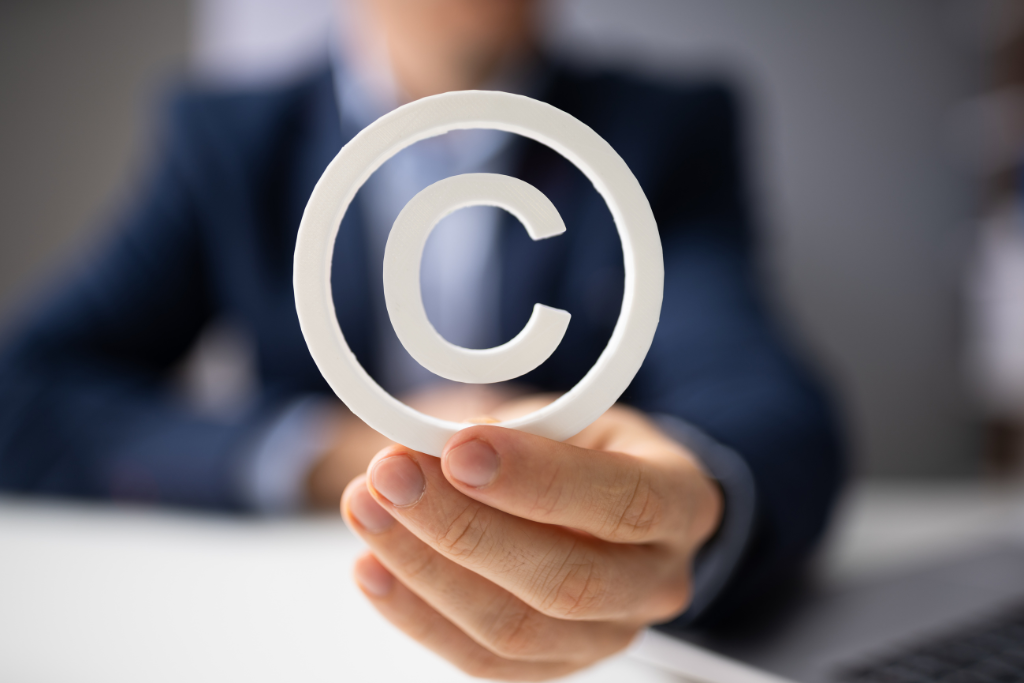
Copyright is a term for a legal right given by the particular national law that gives restrictive rights to the author of a unique work for its utilization or distribution. As a rule, such a right is given for a certain period and has time frames. These rights are not total but rather restricted by abridgments and special cases of copyright law, in particular, fair use. The key point of copyright is that it secures just a certain way or form in which an idea was originally expressed, but not the idea itself.
Copyright guarantees the protection of intellectual property, specifically types of creative work. Unlike a patent or trademark for business, copyright does not require special approval or a document, as this right is automatic. An official recording is required to enhance the rights, but not obligatory. On the Internet, when using different types of information for website copyright, you need to get permission from the owner to use the work.
Copyright is a special kind of law in every state. Anyway, there is nothing like global copyright law. About 180 states have signed the Berne Convention – a treaty managed by the World Intellectual Property Organization (WIPO). It establishes basic standards to protect the rights of the authors of copyrighted works worldwide. What’s more, there were endeavors to enact copyright laws in Europe and other regions. The situation is different regarding copyright on the Internet – the rules are the same.
As a rule, national legal systems that concern copyright law distinguish moral and economic rights within copyright.
The USA and the United Kingdom, Australia, Canada, and New Zealand, have a tendency to decrease the presence of moral rights for an accentuation on financial part – the economic aspect of copyright. Moral rights allude to the concept that a copyrighted work is a statement of the identity and the idea of humanity of its creator or maker.
Economic rights refer to the exploitation of copyright works. They admit the privilege of the author to use, to approve utilization, or to disallow the utilization of the product, to establish the conditions for utilization of the work. Distinctive particular uses (or “demonstrations of misuse”) of a work can be dealt with independently, implying that the rightsholder can manage every right (utilizing, exchanging, permitting or offering the right) on an individual kind of utilization premise.
Fair use
Fair use is the use of the original work for the essential purpose. It’s not the same term as plagiarism; referencing and adding a link to the original is not what’s called “fair use”. Fair use is the reasonable use of works or their copies for the special scope of purposes such as educational, informative, commenting, and criticism. Of course, such use of the work must not cause any harm to the author. This term is especially important for the website copyright, particularly connecting social media and the law.
In the United Kingdom and Ireland, Canada, Hong Kong, Australia, and New Zealand, the rule of “fair use” defines a significant extent of employment where preliminary consent is not required. The list of what is fair use is recorded in law in each of those states, without specifying a particular conceivable use. In the United States (and Israel, Poland, and conceivably a couple of different nations), the idea of “fair use” regard certain utilizations that are considered not to encroach on the privileges of the copyright holder adequately, and/or are regarded to serve an adequately critical open strategy objective, that they are allowed without the approval of the copyright holder. The variables surveyed by a court to decide reasonable use are put forward in every nation’s statute and case law.
The most frequent use of the copyright law with the virtual assistant is copyright online. Copyright on the Internet has the same rules as the general copyright, except for some special peculiarities. If the author downloads the work to the public domain, and the author notes that this content is for public use, everyone can use this work without breaking the Internet copyright. In other cases, it’s necessary to get permission from the author, especially if the work is on a social media resource. This is how social media and the law work.
Nowadays, Copyright and the Internet are closely related to each other. There is tons of visual information on the Internet, including images and photos. Photo and image copyright rules bind to use the original image without transforming it or spoiling its quality. Virtual assistants recommend that you use the rules of photo copyright to avoid legal issues and huge fines for it.
Fair use may have an exception allowing you to use copyrighted images, but you can be involved in a discussion or possibly find your site taken down by your host if the copyright holder disagrees. Unfortunately, there are no significant cases that establish hard-and-fast rules when it comes to fair use and images used on the Internet.
Fair use might serve as a special case permitting you to utilize copyrighted material, images, or copyrighted articles, but you risk being in for a dialog or potentially having your site pulled down with your host in case the copyright holder doesn’t agree. Unfortunately, there are no huge cases that set up firm standards with regard to fair use of works on the Internet. Complying with the simple rules above will help you to save a good reputation and avoid legal issues.